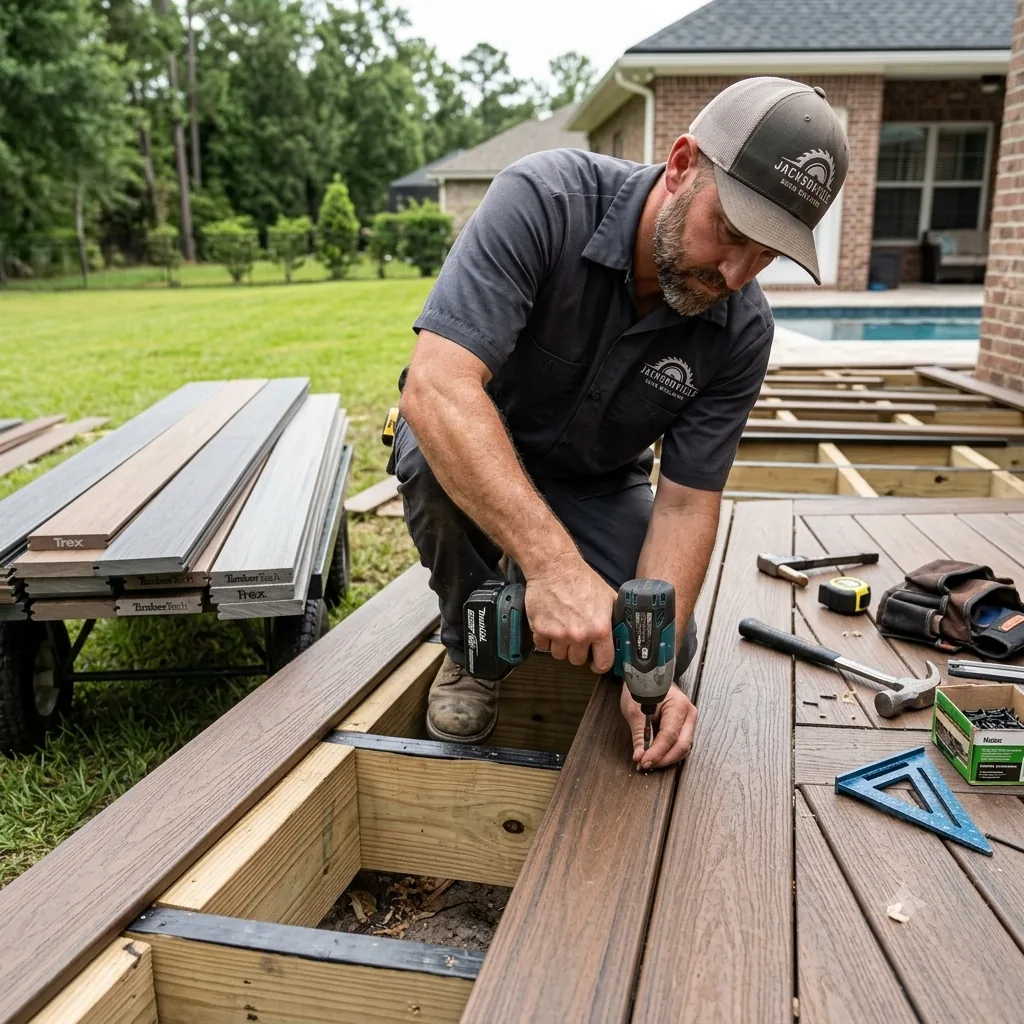
Capped composite is the closest thing Jacksonville has to a build-it-once deck. It won’t rot in our humidity, won’t splinter under bare feet, and won’t ask you to spend a Saturday every spring sanding and sealing. We install Trex, TimberTech and Deckorators across Duval County — and we install them the way the manufacturers actually specify, which is the part that determines whether you get 25 years or 10.
Why Composite Decking Is Best for Jacksonville’s Humidity and Salt Air
Wood decks and Jacksonville weather have an adversarial relationship. Our summers pair 90-degree heat with afternoon thunderstorms, so a wood board soaks, swells, dries and shrinks over and over. That cycle is what opens up cracks, lifts fasteners and eventually turns a deck gray and splintery. Add coastal salt if you’re near the Intracoastal or the beaches, and the clock runs even faster.
Capped composite sidesteps most of that. The core is a wood-flour-and-polymer blend, and the cap is a hard polymer shell bonded around it on all four sides. Water never really gets into the board, so there’s nothing for mold to eat and nothing to rot. The cap also carries the UV inhibitors and the color, which is why a modern capped board holds its tone for decades instead of fading to gray in three summers.
Trex vs. TimberTech vs. Deckorators: Which Composite Decking Is Best in Florida?
Trex is the name most homeowners walk in already knowing. Their Transcend and Enhance lines cover most Jacksonville budgets, and the fade-and-stain warranty is legitimately strong. Trex tends to run slightly warmer underfoot in dark colors, which matters if you’re doing a pool surround in full sun.
TimberTech (including their PVC lines) is our go-to when heat is a real concern. Their PVC boards have no wood content at all, which means they’re the most moisture-immune option on the market and typically run cooler than comparable composites in the same color. They’re a favorite for our beach and riverfront clients.
Deckorators makes a mineral-based composite that’s remarkably light and rigid, and it doesn’t absorb water at all — useful on docks and anywhere the deck sees standing water. It also has the best slip resistance of the three in our experience.
We bring physical samples to every estimate. Reading about board color online is nothing like holding two browns side by side in your own backyard at 4pm, with your house behind them.
How to Tell a Good Composite Deck Installation From a Bad One
Composite decking is more forgiving than wood in almost every way except one: it moves. It expands and contracts along its length with temperature, more than wood does. If an installer butts boards tight the way they might with pine, a Jacksonville August will push those boards into each other and you’ll get buckling, popped fasteners and gaps in odd places.
So we follow the gapping schedule the manufacturer publishes — end gaps and side gaps sized to the board and the install temperature. We also keep joist spacing at 16 inches on center (or 12 inches for diagonal patterns), because composite is not as stiff as wood and will telegraph a bouncy substructure straight into how the deck feels underfoot.
Fasteners matter too. We use hidden fastener systems so you get a clean, screw-free surface, and stainless hardware anywhere near salt air. Cheap coated screws near the Intracoastal will streak rust down a beautiful board within a couple of seasons.
Composite Deck Framing: Why the Substructure Still Matters
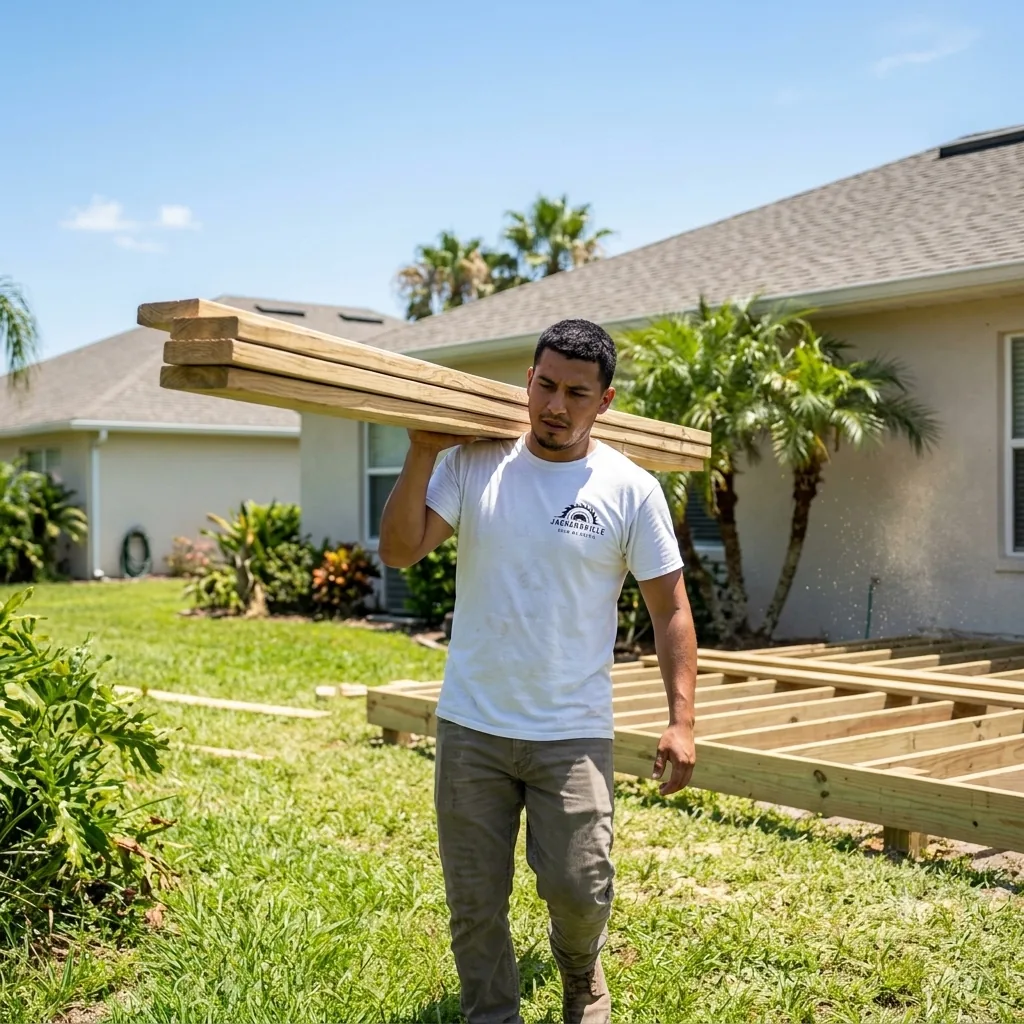
Here’s something a lot of homeowners don’t realize: your composite deck still sits on a pressure-treated wood frame. The boards may last 30 years, but the frame underneath has to last that long too, or you’ll be tearing off a perfectly good surface to fix joists. We use properly rated pressure-treated lumber, protect the joist tops with butyl flashing tape, and use galvanized or stainless joist hangers appropriate to your distance from salt water. It adds a little to the build and it’s the difference between a 15-year deck and a 30-year deck.
How Much Does a Composite Deck Cost in Jacksonville, FL?
Most composite decks we build in Jacksonville land between $35 and $60 per square foot installed, depending on the line you choose, the railing, the height off the ground and how complex the shape is. A straightforward 300-square-foot composite deck with matching railing typically falls in the $12,000–$18,000 range. Multi-level decks, built-in seating, lighting and pool surrounds move that up.
Composite costs more on day one than pressure-treated pine. Over ten years, with zero sealing and near-zero board replacement, the gap narrows considerably — and you get back all those maintenance weekends.
What to Expect From Your Composite Deck Installation in Jacksonville
We come out and measure, talk through how you use the yard, and put samples in your hands. You get a written, itemized quote within 48 hours. We pull the Duval County permit, build with our own crew, and walk the finished deck with you before we call it done. Most composite decks take one to two weeks on site once the permit clears.
Get a Free Composite Deck Building Estimate in Jacksonville
We’ll come out, measure, put real material samples in your hands and send you a written, itemized quote within 48 hours. There’s no charge and no obligation. Request your free estimate or call (904) 555-0142.
Most composite decks here run $35–$60 per square foot installed. A 300 sq ft composite deck with matching railing typically lands between $12,000 and $18,000. Board line, railing style, deck height and shape complexity are the biggest cost drivers. Every quote we give is itemized in writing.
All three are excellent; they just have different strengths. Trex has the broadest color range and strong brand recognition. TimberTech’s PVC lines run cooler underfoot and are the most moisture-immune, which we like for beach and riverfront homes. Deckorators’ mineral-based boards have the best slip resistance and absorb no water at all. We bring samples so you can compare in your own yard.
Any decking gets warm in direct Florida sun, and darker colors get warmest. Lighter tones and TimberTech’s PVC lines run noticeably cooler than dark composites. If your deck is in full sun or wraps a pool, we’ll steer you toward the cooler-running colors and lines rather than let you find out in July.
The boards themselves commonly carry 25- to 50-year fade-and-stain warranties and routinely outlive that. The real lifespan question is the pressure-treated frame underneath. We flash the joists and use corrosion-appropriate hardware specifically so the substructure lasts as long as the surface.
Modern capped composite resists both far better than the uncapped boards from 15 years ago. You may see very slight tonal settling in the first few months as the boards weather in, which is normal. Grease, wine and pollen wash off with soap and water rather than soaking in the way they do with wood.
Sometimes — but only after we inspect it. The frame has to be structurally sound, correctly spaced (16 in. on center for straight patterns) and free of rot. If it checks out, re-decking over it saves real money. If it doesn’t, we’ll tell you honestly rather than lay expensive boards on a failing structure.
Low maintenance, not no maintenance. A wash with soap, water and a soft brush twice a year handles Jacksonville pollen and the mildew film that grows in shaded corners. No sanding, no staining, no sealing. Go easy with a pressure washer — wide tip, low setting, or you risk damaging the cap.
Yes, in nearly every case. Attached decks and elevated decks require a permit and inspection through the City of Jacksonville. We handle the entire process — drawings, submission and meeting the inspector — as part of the build.
Absolutely, and it’s a great choice because it won’t splinter under bare feet. We steer pool clients toward lighter colors and slip-resistant lines like Deckorators, and we detail the transitions carefully around coping, pavers and screen cages.
Not when they’re installed correctly. Composite expands and contracts along its length more than wood does, so proper end and side gapping is critical. Installers who butt the boards tight cause the buckling you’ve heard about. We follow each manufacturer’s published gapping schedule for the install temperature.
Most composite decks take one to two weeks of on-site work after the permit clears. Permitting typically adds one to three weeks up front. Multi-level decks, pergolas, lighting and pool surrounds extend the timeline, and we give you a dated schedule before we start.
If you plan to stay in the home more than five or six years, usually yes. Pine is cheaper up front but wants cleaning and re-sealing every one to three years plus occasional board swaps. Composite eliminates that entirely. Over a decade the total cost of ownership converges — and you get every one of those maintenance weekends back.
Ready When You Are
Let’s Build Your Dream Deck
Free estimates across Jacksonville and Northeast Florida. Call now or request your quote online.