Dock Building & Waterfront Decks in Jacksonville, FL
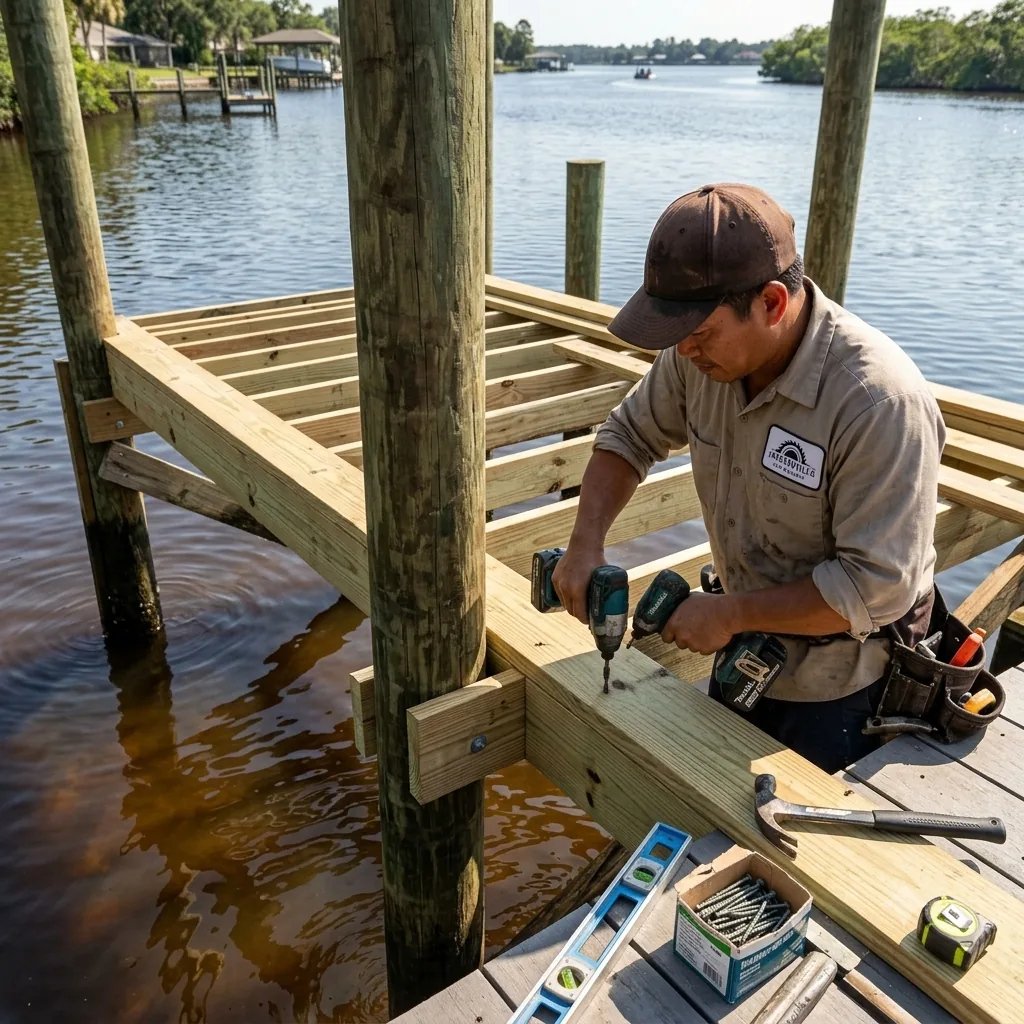
Building on the water is a different discipline. Tides move, pilings settle, salt eats hardware, and the permitting gets a second layer. We build docks, boardwalks and elevated waterfront decks along the St. Johns River, the Intracoastal and the Jacksonville creeks — with the marine-grade materials and elevation detailing that shoreline construction actually demands.
Marine-grade pilings driven to site-specific depth
Stainless steel fasteners & connectors
Flood-zone & shoreline setback compliant design
Fixed docks, piers, boardwalks & elevated decks
Composite, pine or hardwood decking
Tidal range & storm surge factored into elevation
Dock Building vs. Deck Building: Why Waterfront Construction Is Different
People sometimes assume a dock is just a deck with a better view. Structurally it’s a different animal. A backyard deck sits on footings in stable soil and mostly worries about gravity. A dock sits in moving water, on pilings driven into soft substrate, and has to handle tidal cycles, wave action, boat wakes, current, and the occasional storm surge trying to lift the whole thing off its posts.
That changes everything: how deep the pilings go, how the frame is tied together, which fasteners survive, and how the deck is anchored against uplift. Getting it wrong doesn’t mean a squeaky board — it means a structure that racks, leans or floats away.
How Deep Do Dock Pilings Need to Be on the St. Johns River?
The pilings are the dock. Everything else is carried by them. We use treated marine-grade pilings driven to a depth appropriate for the substrate at your site — and along the St. Johns and its creeks, that substrate varies enormously from one property to the next. Sandy bottom, mud, clay, and old fill all behave differently.
Depth and diameter get specified for your location, not from a generic table. Under-driven pilings in soft mud will settle and lean within a few seasons, and there’s no cosmetic fix for that. This is the least glamorous line item on the estimate and the one we will not cut.
Why Saltwater Docks in Jacksonville Need Stainless Steel Hardware
Standard galvanized hardware near salt water is a slow-motion failure. It streaks, it pits, and it loses strength at exactly the connection points holding your dock together. On saltwater and brackish sites — which is most of the Intracoastal and much of the lower St. Johns — we use stainless steel fasteners and connectors.
The upcharge is real and it is trivial compared to re-fastening or rebuilding a dock in eight years. If a bidder is meaningfully cheaper than everyone else on a waterfront job, the hardware spec is frequently where the money came from. Ask them.
Best Decking Material for a Dock in Florida
Pressure-treated pine is the traditional and most affordable dock surface, and it works — with the understanding that it will need sealing and periodic board replacement.
Composite has become very popular on docks because it doesn’t splinter under bare feet, doesn’t rot, and needs almost nothing from you. Mineral-based composites like Deckorators are especially good here because they absorb no water at all and hold their grip when wet.
Tropical hardwood is the premium option: gorgeous, extraordinarily durable, and priced accordingly.
Do You Need a Permit to Build a Dock in Jacksonville? Flood Zones Explained
Waterfront properties in Jacksonville carry an extra permitting layer beyond the standard Duval County deck permit. Depending on your site you may face shoreline setback review, flood-zone elevation requirements, and in some cases state or federal review for structures extending into navigable water.
Practically, this means: the design has to be right before it goes in, and the timeline is longer than an ordinary backyard deck. We handle the drawings and the submissions, and we tell you up front what your site is likely to require rather than discovering it halfway through.
Elevation matters structurally too. A dock built too low takes a beating from wave action and storm surge. We set the deck height with tidal range and surge in mind, not just what looks nice at low tide on the day we measured.
Docks, Piers and Boardwalks We Build in Jacksonville
Fixed docks and piers. Boardwalks across marsh and bulkhead. Elevated waterfront decks that step down toward the river. Dock extensions and re-decking of existing structures. Railing, benches, and low-voltage lighting for evening use. If you’re thinking about a boat lift or slip, we’ll coordinate the framing to accommodate it.
How Much Does It Cost to Build a Dock in Jacksonville, FL?
Waterfront work costs more than backyard decking, and the range is wider because sites vary so much. Pilings, water depth, access for equipment, decking selection and permitting all swing the number substantially. We’d rather look at your shoreline than quote you a fantasy over the phone — the site visit is free and it’s the only honest way to price this work.
Expect the permitting phase to run longer than a standard deck. Once approved, construction timelines depend heavily on water access and piling work.
Get a Free Docks & Waterfront Decks Estimate in Jacksonville
We’ll come out, measure, put real material samples in your hands and send you a written, itemized quote within 48 hours. There’s no charge and no obligation. Request your free estimate or call (904) 555-0142.
Dock pricing varies more than any other work we do, because sites vary enormously. Piling depth, water depth, equipment access, decking choice and permitting all swing the number. We won’t quote a dock over the phone — the free on-site visit is the only honest way to price shoreline work.
Almost certainly yes, and more than one. Beyond the standard Duval County permit, waterfront projects can trigger shoreline setback review, flood-zone elevation requirements, and for structures extending into navigable water, state or federal review. We handle drawings and submissions and tell you what your site needs up front.
Stainless steel fasteners and connectors on saltwater and brackish sites. Standard galvanized hardware near salt corrodes at exactly the connection points holding the dock together. It’s a small upcharge that prevents a very expensive failure.
It depends entirely on your substrate. Sandy bottom, mud, clay and old fill all behave differently, and along the St. Johns it varies from property to property. We specify depth and diameter for your site rather than from a generic table — under-driven pilings in soft mud will lean within a few seasons and there’s no cosmetic fix for that.
Pressure-treated pine is the affordable traditional choice and works fine with sealing and occasional board swaps. Composite is increasingly popular because it won’t splinter bare feet and needs almost no upkeep — mineral-based lines like Deckorators are especially good since they absorb no water and grip well when wet. Tropical hardwood is the premium option.
Often, yes. If the pilings and structural frame are sound, we can replace the decking surface and railing for far less than a full rebuild. If the pilings are leaning or the frame is racking, that’s structural and needs to be addressed first. We’ll inspect and tell you straight.
We build and frame docks to accommodate lifts and slips, and we’ll coordinate the structure so a lift can be integrated properly. Tell us at the design stage if a lift is in your plans now or later — framing for it up front is far cheaper than retrofitting.
High enough to clear your tidal range and take storm surge and wave action without constant pounding, but low enough to be usable at low tide. We set the elevation deliberately based on tidal data for your location rather than what looks right on the day we happened to measure.
Permitting on waterfront work typically runs longer than a standard backyard deck. Once approved, construction time depends heavily on piling work and water access — a site the barge can reach easily moves faster than one that can’t. We give you a realistic schedule after the site visit.
No one can promise that about any structure in a major storm. What we can do is build to code, set the elevation with surge in mind, use marine-grade pilings driven to proper depth, and detail the connections to resist uplift. A properly built dock has a dramatically better chance than one that cut corners on pilings and hardware.
Yes. Elevated boardwalks across marsh and to bulkheads are a common request on the Jacksonville creeks and river. They carry their own permitting considerations around wetland impact, which we’ll walk you through.
Yes, and we recommend it — a dark dock is a hazard at night. We install low-voltage LED post and stair lighting rated for marine environments. It makes evening use safe and, frankly, makes the dock look spectacular from the house.
Ready When You Are
Let’s Build Your Dream Deck
Free estimates across Jacksonville and Northeast Florida. Call now or request your quote online.