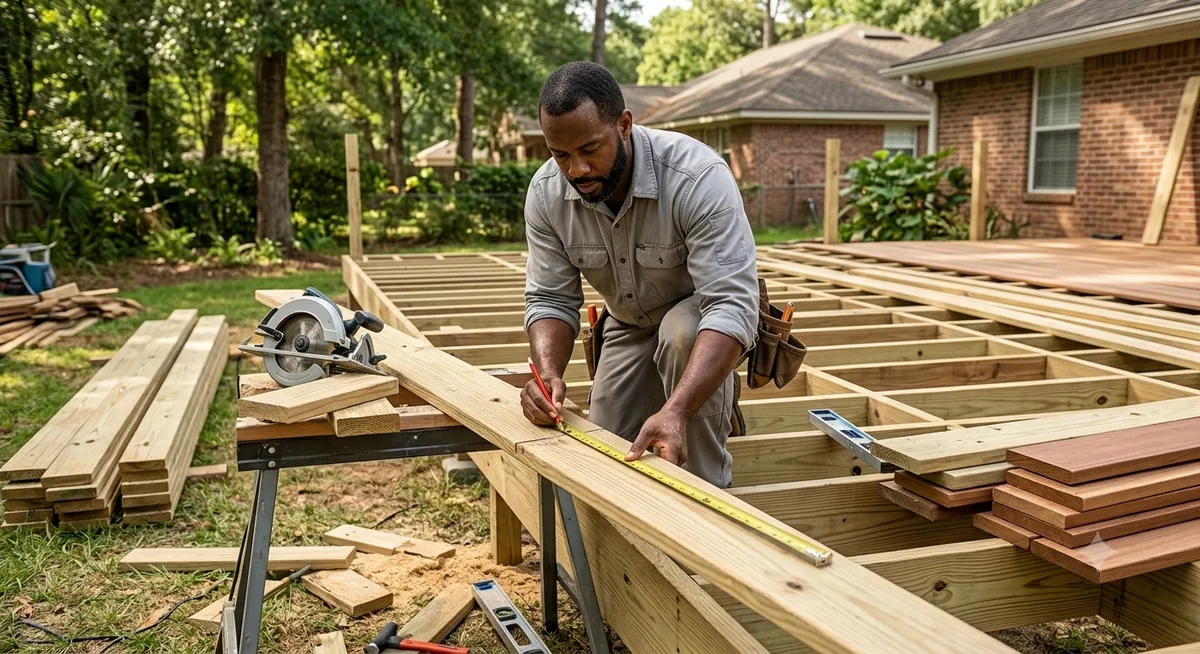
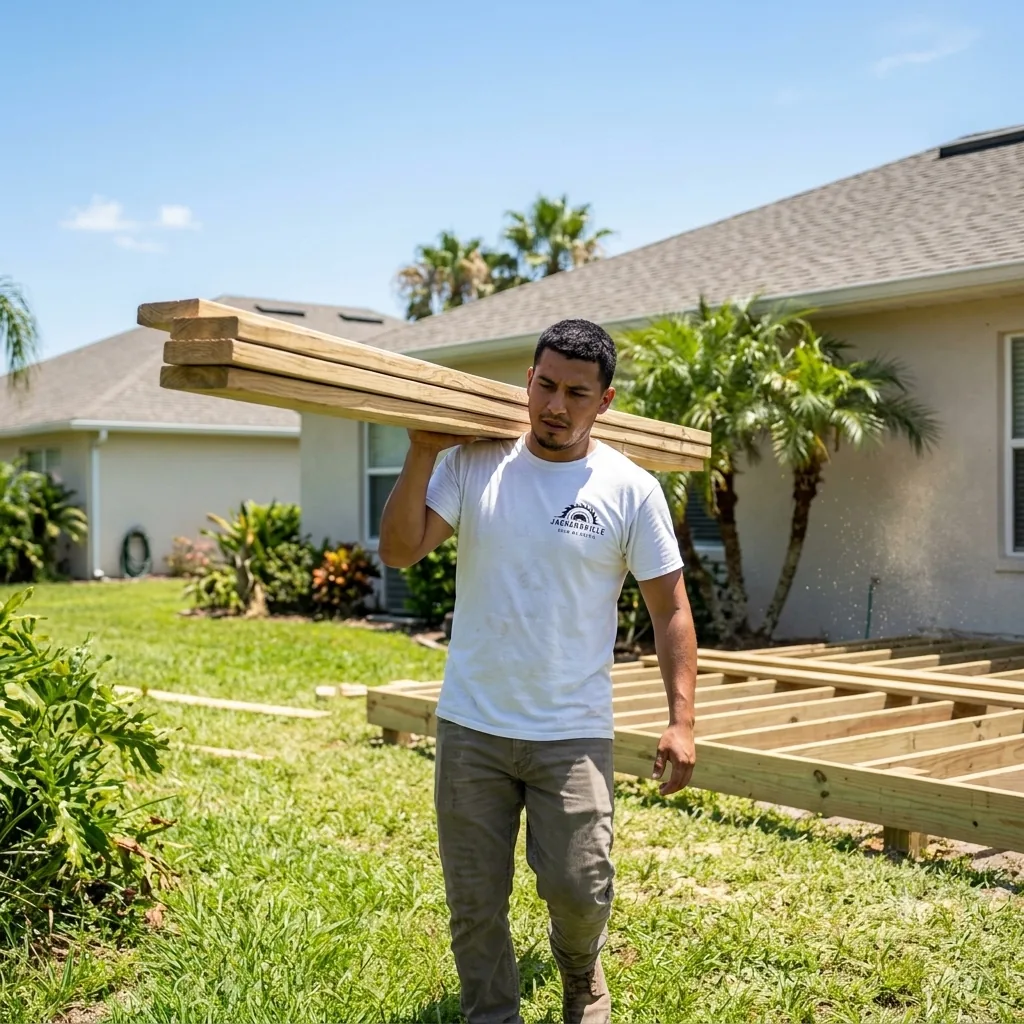
There is still nothing that looks or feels quite like a real wood deck. Warm underfoot, honest grain, and a price point that gets a lot of Jacksonville families outside for the first time. We build pressure-treated pine, cedar and tropical hardwood decks — and we build them knowing exactly what Florida is going to throw at them.
Properly flashed ledger — protects your home’s wall
Hot-dipped galvanized or stainless fasteners
Correct board gapping for Florida drainage
Framing sloped to shed water
Stain & sealer guidance included
Why Choose a Wood Deck in Jacksonville? Three Real Advantages
Cost is the obvious one. A pressure-treated pine deck typically runs about a third of the material cost of premium composite, which means a 300-square-foot deck can start near $6,500 instead of $14,000. For a lot of homeowners, that difference is what makes the project happen at all.
The second is feel. Real wood has a give and a warmth that polymer boards approximate but never quite match, and it stays cooler underfoot in full sun than most dark composites.
The third is repairability. When a wood board fails, you pull it and put in a new one for a few dollars. Wood is forgiving that way, and it’s a genuinely underrated advantage.
Pressure-Treated Pine vs. Cedar vs. Ipe: Best Wood for a Florida Deck
Pressure-treated southern yellow pine is the workhorse. It’s chemically treated to resist rot and termites, it’s widely available, and it’s affordable. The tradeoff is that it’s a soft wood that moves a lot as it dries, and it wants a cleaning and re-seal every one to three years in our climate.
Cedar is naturally rot- and insect-resistant, more dimensionally stable than pine and considerably prettier. It costs more and it’s softer than hardwood, so it dents, but it holds a stain beautifully and it smells wonderful while we’re building it.
Tropical hardwoods — ipe most commonly — are the top of the wood world. Ipe is so dense it barely absorbs water, resists rot and insects with no chemical treatment at all, and can last 40 years. It’s also expensive, brutally hard on tools, and requires pre-drilling every fastener. When a client wants a wood deck that will outlive them, this is it.
How Florida Humidity and Rain Damage a Wood Deck — and How We Prevent It
The enemy is water sitting where it shouldn’t. Our humidity keeps wood damp, our storms soak it, and our heat then bakes it. So the whole build strategy is about keeping water moving.
We gap the boards correctly so water drains through rather than pooling on the surface. We slope the framing subtly away from the house. We flash the ledger — the board that attaches the deck to your house — because a poorly flashed ledger is the single most common cause of both deck failure and rot inside your home’s wall. And we keep the wood up off the dirt, because ground contact is where pine goes to die.
Hardware is the other half. Pressure-treatment chemicals are corrosive to ordinary steel, so we use hot-dipped galvanized or stainless fasteners rated for contact with treated lumber. Near the beaches or the Intracoastal, we go stainless, full stop. Salt air will eat cheaper hardware and leave rust streaks running down your new boards.
How Often Should You Seal a Wood Deck in Jacksonville?
A wood deck in Jacksonville is a relationship, not a purchase. Expect to wash it and re-apply a quality water-repellent sealer or stain every one to three years, depending on sun exposure. Expect to replace the occasional board over a 15-year life. Expect it to gray gracefully if you let it.
If that sounds like a chore you’ll resent, we’ll tell you honestly that composite is a better fit for you — we’d rather steer you right than sell you a deck you’ll come to dislike. If it sounds like a satisfying spring weekend, wood is a wonderful, affordable, beautiful choice.
How Much Does a Wood Deck Cost in Jacksonville, FL?
Pressure-treated pine decks generally run $22–$35 per square foot installed in the Jacksonville area. Cedar lands higher. Ipe and other tropical hardwoods can approach or exceed premium composite pricing because both the material and the labor are more demanding. Railing style, deck height, stairs and framing complexity all move the number.
Getting a Free Wood Deck Estimate in Jacksonville
We come out free of charge, measure, and talk through species, stain colors, railing and layout. Written itemized quote inside 48 hours. We pull the Duval County permit, build with our own crew, and hand you a deck backed by a written workmanship warranty.
Get a Free Wood Deck Building Estimate in Jacksonville
We’ll come out, measure, put real material samples in your hands and send you a written, itemized quote within 48 hours. There’s no charge and no obligation. Request your free estimate or call (904) 555-0142.
Pressure-treated pine decks typically run $22–$35 per square foot installed, so a 300 sq ft deck often starts near $6,500. Cedar costs more, and tropical hardwoods like ipe can approach premium composite pricing. Railing, stairs, deck height and framing complexity all affect the final number.
Plan on cleaning and re-applying a quality water-repellent sealer or stain every one to three years. Decks in full sun weather faster than shaded ones. Skipping it is what leads to the gray, cracked, splintery deck most people picture when they think of old wood decks.
Yes. Modern pressure-treated lumber uses copper-based preservatives rather than the arsenic-based CCA that was phased out of residential use in 2003. It’s the standard material for residential decks nationwide. We still recommend sealing it, which further limits any surface contact with the treatment.
A well-built and consistently maintained pressure-treated deck commonly lasts 15–20 years here. Cedar can go longer. Ipe can last 40 years. A neglected pine deck — never sealed, poorly drained — can start failing in under a decade, which is why the build details and the upkeep both matter.
For value, properly treated southern yellow pine. For a balance of beauty and durability, cedar. For maximum lifespan with no chemical treatment, ipe or another tropical hardwood. We’ll walk through the tradeoffs against your budget and how long you plan to stay in the home.
Yes, but the hardware changes. Salt air corrodes ordinary and even standard galvanized fasteners, so we specify stainless for homes near the Intracoastal, the St. Johns or the beaches. We also pay extra attention to elevation and airflow beneath the deck.
The ledger is the board that fastens your deck to the house. If it isn’t flashed properly, water runs behind it and into your wall — rotting the framing of your home, not just your deck. Improper ledger attachment is one of the leading causes of deck collapse nationally. We flash and fasten it to code, every time.
Almost always. Attached and elevated decks require a permit and inspection through the City of Jacksonville / Duval County. We handle drawings, submission and inspections as part of every full build.
Most residential wood decks take about one to two weeks of on-site work once the permit is approved. A simple ground-level platform can go faster; multi-level decks with stairs and railings take longer. Permitting typically adds one to three weeks before we start.
Not usually. Fresh pressure-treated lumber is often still wet with treatment and needs to dry — typically a few weeks to a few months depending on weather — before it will accept a stain properly. We’ll tell you when yours is ready and what product we’d use.
It depends on the frame. If the posts, beams and joists are sound, re-decking the surface and replacing the railing is dramatically cheaper than a rebuild. If the structure is compromised, patching it is throwing money away. We do free honest inspections and price both paths.
Pressure-treated lumber is specifically treated to resist termites and rot, which is why we use it for framing and ground-adjacent components. Keeping the wood off the soil, maintaining drainage, and not stacking firewood or mulch against the deck all reduce risk further.
Ready When You Are
Let’s Build Your Dream Deck
Free estimates across Jacksonville and Northeast Florida. Call now or request your quote online.