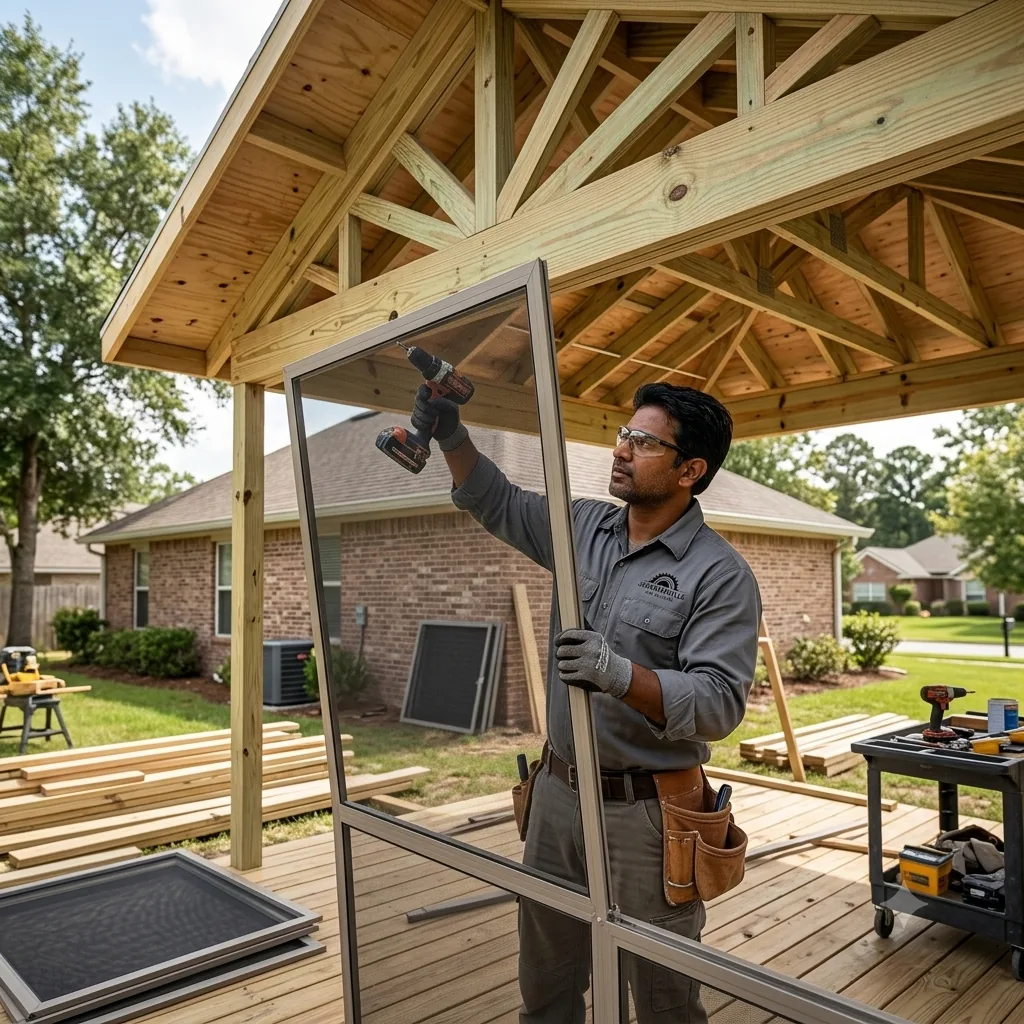
A deck you can only use from October to April isn’t a deck — it’s a platform you look at. Screening it or covering it is the single highest-impact upgrade we do, because it turns a seasonal space into a room you actually live in. Mosquitoes out, no-see-ums out, afternoon downpour handled, brutal 3pm sun handled.
Our climate gives with one hand and takes with the other. The weather is gorgeous… and the mosquitoes and no-see-ums arrive at exactly the hour you want to be outside. The sun is glorious… and it makes an unshaded deck unusable from noon to five in July. The afternoon thunderstorm rolls through… and everyone goes inside.
Screening and covering attack all three. Most of our clients tell us the same thing afterward: they went from using the deck a handful of times a year to using it most evenings.
Screened Porch vs. Covered Deck vs. Pergola: Which Should You Build?
A screened porch is an enclosure with a roof and screen walls. It stops insects entirely and gives you shade and rain protection. This is the full solution, and it’s what most people picture.
A covered deck has a roof but open sides. You get shade and rain protection and keep the open-air feel and the breeze — but the bugs still come. Great for grilling zones and for people who want cover without feeling boxed in.
A pergola gives partial, dappled shade and a lot of architectural character, but it isn’t weather protection and it doesn’t stop bugs. Beautiful, and a different tool for a different job. (We build those too — see our pergolas and outdoor living page.)
A common winning combination: screen the main seating area, leave an adjacent open deck section for the grill and the sun-lovers.
Best Screen for a Florida Porch: Why No-See-Um Mesh Matters
Standard fiberglass screen keeps mosquitoes out. It does not reliably stop no-see-ums, which are small enough to pass through standard mesh — and if you’ve been bitten by them at dusk near the water, you know they’re the real enemy. If no-see-ums are an issue at your property (and near the marsh, the river or the beaches, they are), we use a finer “no-see-um” mesh. It cuts airflow slightly. It’s worth it.
Pet-resistant screen is a heavier weave that stands up to dogs and cats pushing against it. Solar screen reduces heat gain and glare on a west-facing porch, which in Jacksonville is a genuine comfort upgrade.
Gable, Shed or Insulated Roof: Best Screened Porch Roof Styles
A gable roof (the peaked, open-truss look) creates volume and lets us leave the ceiling open to the framing, which feels dramatic and airy. It sheds our heavy rain beautifully.
A shed roof slopes in one direction, ties in simply under the existing roofline, and costs less. Very clean, very practical.
An insulated roof panel costs more but noticeably reduces heat radiating down onto you, which under a Florida sun is not a small thing.
Whatever the style, tying the new roof into your existing roofline correctly — with proper flashing — is critical. A badly integrated porch roof leaks into your house, and that is an expensive lesson.
Screened Porch Ideas: Ceiling Fans, Lighting and Outlets
A ceiling fan. Every single time. In Jacksonville a fan is the difference between a screened porch being pleasant and being a hot box in August — moving air is what makes it work. Wire for it during the build; retrofitting is a pain.
Lighting, so the space is usable after dark. Outlets, so you can actually plug in a lamp or a TV. And if you’re a serious outdoor cook, tell us early so we can plan the grill area with proper clearance and ventilation — a grill under a low, unvented roof is a fire hazard.
Do You Need a Permit for a Screened Porch in Duval County?
A roofed structure is a bigger permitting deal than an open deck. It affects your home’s footprint and drainage, it has to handle Florida wind loads, and it has to tie into your existing structure properly. Expect a permit, expect inspections, and expect the timeline to be longer than a simple deck. We handle all of it.
How Much Does a Screened Porch Cost in Jacksonville, FL?
A screened enclosure typically adds $8,000–$20,000 on top of the deck itself, driven by size, roof style, screen type and how complicated the tie-in to your existing roof is. Insulated roof panels and premium screens move that up. We design the deck and the cover together so the finished result looks intentional and built-in — not like a kit bolted onto an afterthought.
Get a Free Screened & Covered Decks Estimate in Jacksonville
We’ll come out, measure, put real material samples in your hands and send you a written, itemized quote within 48 hours. There’s no charge and no obligation. Request your free estimate or call (904) 555-0142.
A screened enclosure typically adds $8,000–$20,000 on top of the deck itself. The drivers are size, roof style, screen type and how complex the tie-in to your existing roofline is. Insulated roof panels and premium screens push it higher. We quote the deck and the cover together, itemized.
No — and this catches a lot of people. Standard fiberglass mesh stops mosquitoes but no-see-ums are small enough to pass right through it. If you’re near the marsh, the river or the beaches, we use a finer no-see-um mesh. It reduces airflow slightly and it is absolutely worth it.
A screened porch has a roof and screen walls — it stops insects completely and gives shade and rain cover. A covered deck has a roof but open sides, so you get shade and rain protection with an open-air feel, but bugs still get in. Many clients do both: screen the seating area, leave an open section for the grill.
Yes. A roofed structure is a more involved permit than an open deck because it affects your home’s footprint, drainage and wind-load requirements. Expect a permit and inspections, and expect a longer timeline than a simple deck. We handle the drawings, submission and inspections.
Frequently, yes — but the existing deck has to be able to carry the additional load of a roof structure, which many older decks were never designed for. We inspect the framing and footings first. If it can’t carry it, we’ll tell you what would need to be reinforced.
A gable roof creates volume and drama and sheds our heavy rain beautifully. A shed roof is simpler, ties in cleanly under the existing roofline, and costs less. An insulated roof panel costs more but meaningfully cuts the heat radiating down on you — a real comfort factor in Florida. We’ll match the style to your home’s architecture.
Yes. Every client who added one is glad they did, and the ones who skipped it usually ask us to come back. In Jacksonville, moving air is the difference between a screened porch being a pleasure in August and being a hot box. Wire for it during the build — retrofitting is a hassle.
With proper planning, yes — but tell us early. A grill under a low, unvented roof is a genuine fire hazard. We plan the grill area with adequate clearance and ventilation, or design an adjacent open-air section specifically for cooking.
A well-designed one shouldn’t. In fact, shading a wall and windows that previously got direct afternoon sun can reduce heat gain into your home. Insulated roof panels and a ceiling fan both help further. Poorly designed enclosures that trap air with no ventilation are the ones that get hot.
Longer than an open deck — typically two to three weeks of on-site work after permitting, because you’re building a deck, a roof structure and an enclosure. Permitting on roofed structures also runs longer. We give you a dated schedule up front.
Worth it if you have a dog or cat that leans, scratches or pushes on the screen. It’s a heavier weave that resists tearing. We often use it just on the lower panels where pets actually make contact, which controls cost while solving the problem.
Yes, and we take this seriously — a porch roof that clashes with your home looks bolted-on forever. We match shingle type and color where possible and design the pitch and tie-in so the finished structure reads as part of the house. Correct flashing at the tie-in is critical; a bad one leaks into your wall.
Ready When You Are
Let’s Build Your Dream Deck
Free estimates across Jacksonville and Northeast Florida. Call now or request your quote online.