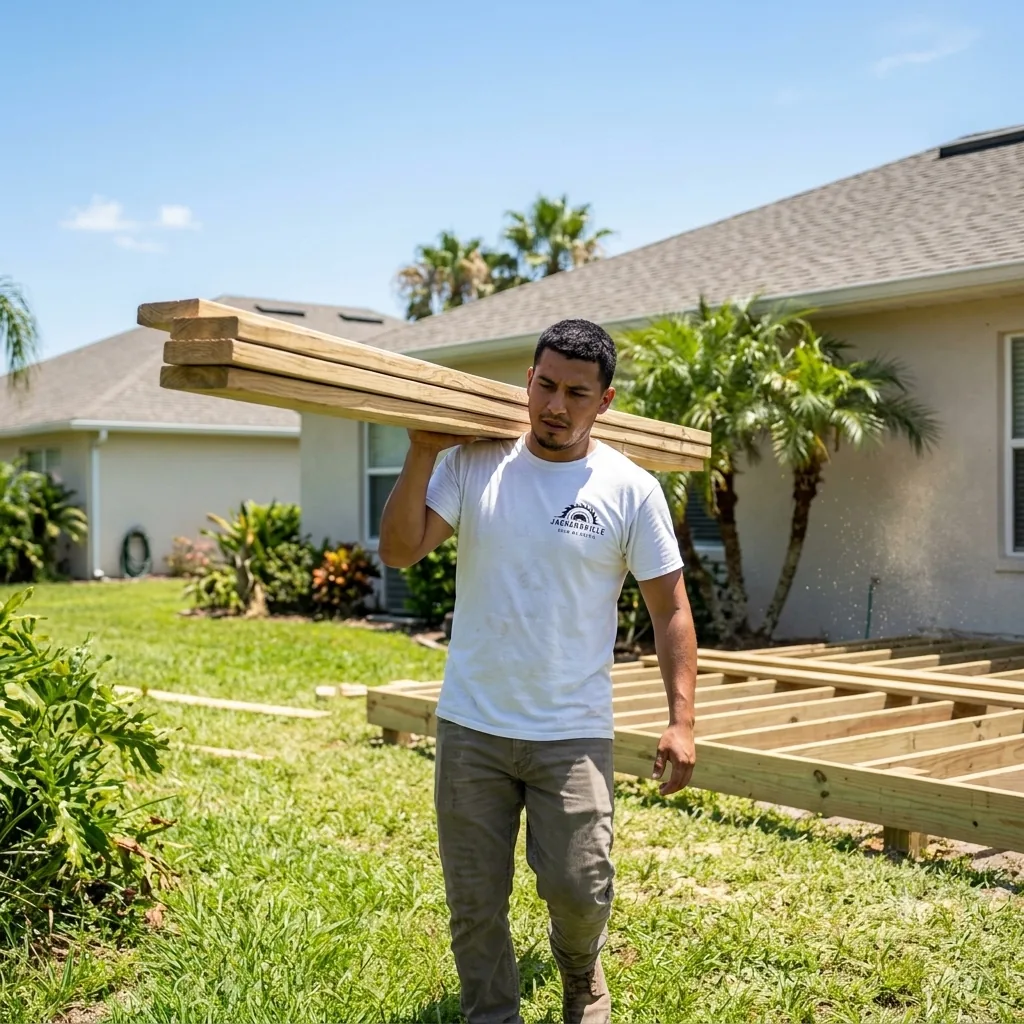
What a Deck Really Costs in Jacksonville: A 2026 Price Breakdown
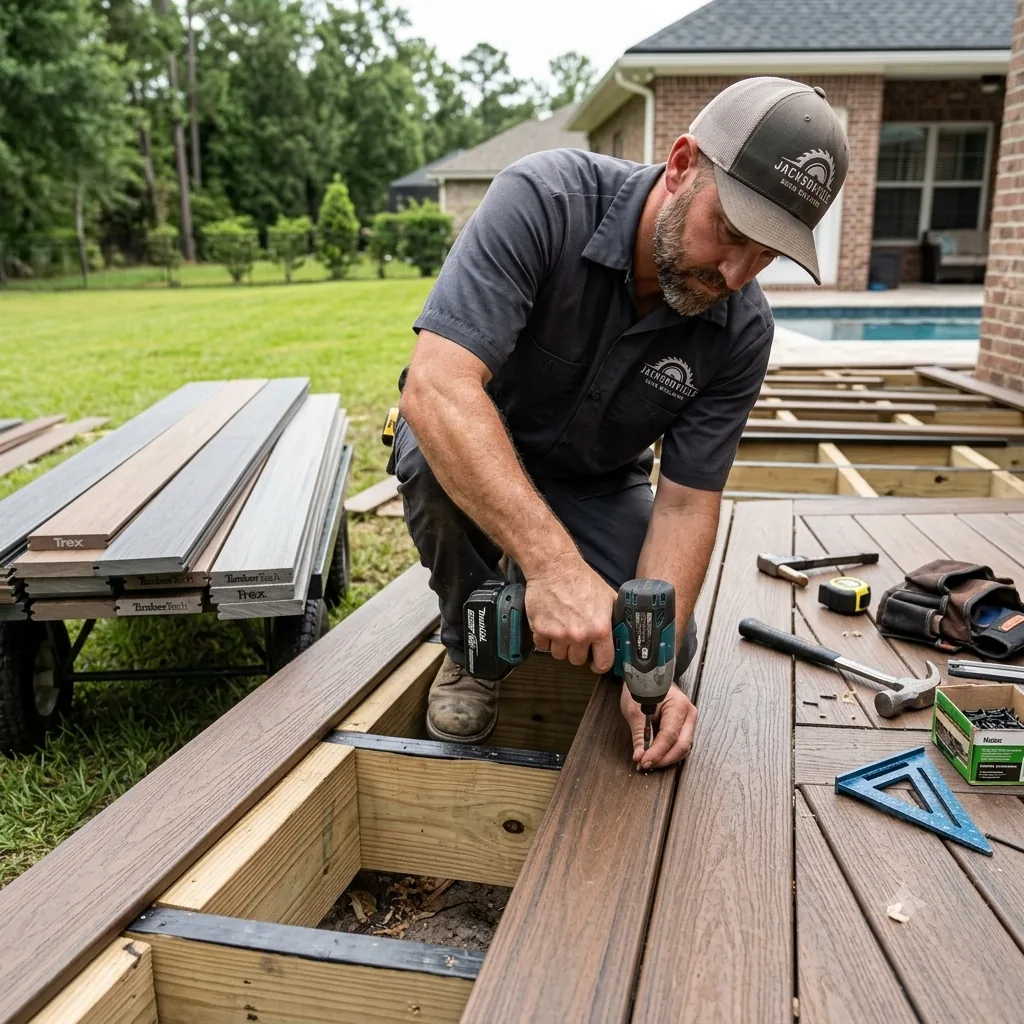
“How much is a deck?” is the first question everyone asks and the hardest one to answer honestly in a sentence. So let’s do it properly — what you’re actually paying for, why two quotes for the “same” deck can differ by $8,000, and where the money quietly disappears when someone underbids.
The headline numbers
In the Jacksonville market, pressure-treated wood decks generally run $22–$35 per square foot installed. Composite decks run $35–$60 per square foot installed. A 300-square-foot deck — a common size — lands roughly at $6,500–$10,500 in wood and $12,000–$18,000 in composite with railing.
Those are wide ranges, and the width is the point. The variables below are what move you within them.
What actually drives the number
Height off the ground. A deck 18 inches off grade is dramatically cheaper than one 8 feet up. Height means longer posts, bigger footings, stairs, and railing everywhere. It also frequently means more permitting scrutiny. This is the single most underestimated cost driver.
Railing. People think of railing as a detail. It’s often 20–30% of the project. Basic pressure-treated railing is cheap; cable rail, aluminum and glass panels cost multiples of that. Any deck more than 30 inches off the ground requires it by code, so it isn’t optional.
Shape. Rectangles are cheap. Every angle, curve, level change and wrap-around costs cutting time and material waste. A multi-level deck with three angles is a fundamentally different job than a rectangle of the same square footage.
Stairs. Stairs are surprisingly expensive per square foot — lots of cutting, lots of framing, code-mandated rise and run, and railing on both sides.
Hardware. On a coastal or riverfront build, stainless fasteners and connectors are mandatory and they cost meaningfully more than galvanized. This is real money and it is not optional near salt.
Site access. If we can back a truck up to the build, materials move fast. If everything has to be hand-carried through a narrow side gate, that’s labor.
Where a cheap bid hides its savings
If one quote comes in dramatically under the others, the money came from somewhere. In our experience it’s usually one of these:
Hardware downgrade. Galvanized instead of stainless near salt. Cheaper joist hangers. Standard screws instead of ones rated for treated lumber. Invisible on day one, expensive in year five.
Wider joist spacing. Going 24 inches on center instead of 16 saves lumber and labor — and gives you a bouncy deck, especially with composite, which is less stiff than wood.
Skipping the permit. It saves fees and weeks. It also means no inspection, potential problems when you sell, and no recourse if something is wrong.
No ledger flashing. Saves an hour and a few dollars of material. Lets water run behind the ledger into your home’s wall framing. This is the one that costs people tens of thousands down the road.
Undersized footings. Cheaper, faster, and the reason some decks start sinking on one corner after three years.
Ask any bidder specifically about these five things. A good contractor will be happy to answer. A cheap one will get vague.
The resurfacing option nobody mentions
If you already have a deck and the frame is sound, you may not need a new deck at all. Re-decking the surface over an existing structure typically costs 40–60% of a full rebuild and makes the deck look brand new. It’s the best value in this entire business, and a contractor who leads with a full rebuild without inspecting your frame isn’t doing you any favors.
What we do
Free on-site visit, real material samples, and a written itemized quote within 48 hours — broken out so you can see exactly what you’re paying for. If you want to compare that against another bid line by line, we welcome it. Request an estimate.
Thinking about a deck project?
Free on-site estimate, real material samples, written itemized quote within 48 hours.