
The One Part of Your Deck That Causes Most Collapses
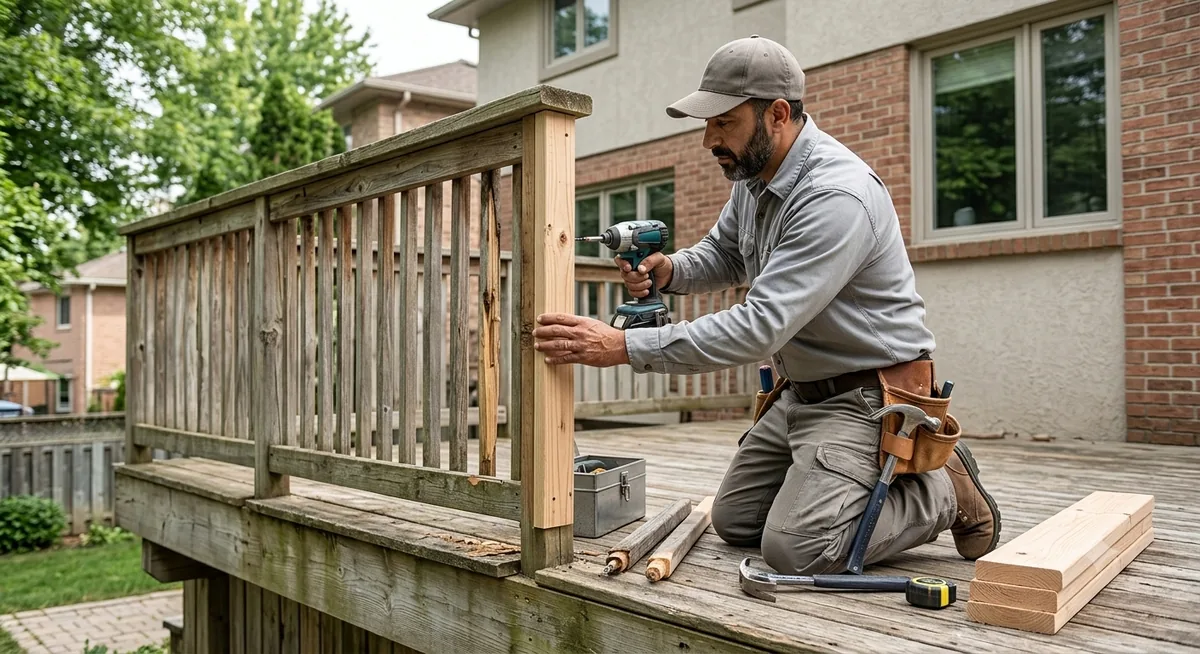
When a deck collapses — and they do, usually at a party, usually with a crowd on them — investigators almost always find the same failure. It isn’t the decking. It isn’t the railing. It’s the ledger.
What a ledger is
The ledger is the horizontal board that attaches your deck to your house. On an attached deck, one entire side of the structure — and a large share of the load — hangs on it. Everything else sits on posts. The ledger sits on your house.
Which means: if the ledger fails, that side of the deck drops. And because the load on a deck is heavily concentrated when people gather, ledger failures tend to happen at exactly the worst moment.
The two ways they fail
Nailed instead of bolted. This is the big one. A ledger must be fastened with through-bolts or approved structural screws designed for the load. Nails — even a lot of nails — are not adequate, because they pull straight out under the kind of shear load a crowded deck applies. Older decks and DIY decks are frequently nailed. It looks fine. It is not fine.
Water behind it. If the ledger isn’t properly flashed, water running down your house’s wall gets behind the ledger board and sits there. In Jacksonville’s humidity it never really dries. Over years, it rots both the ledger and — this is the expensive part — the rim joist and wall framing of your house behind it. Eventually the bolts are anchored in rotted wood, which is to say anchored in nothing.
The second failure mode is more insidious because from the outside everything looks normal right up until it doesn’t.
How to check yours
You can do a basic check yourself. Get under the deck with a flashlight and look at where it meets the house.
Are there bolt heads — large, with washers — or just nail heads? Bolts good, nails bad.
Is there metal flashing visible where the deck meets the wall, tucked up behind the siding and over the top of the ledger? If you see no flashing, water is getting behind that board.
Push a screwdriver or an awl into the ledger and the wood around it. Does it go in easily? Soft wood means rot, and rot at the ledger is not a “keep an eye on it” situation.
Are there rust stains running down from the fasteners? Corroded fasteners lose strength, and the wrong fasteners were probably used to begin with.
What to do if it’s bad
Stop using the deck for gatherings until it’s assessed. That sounds dramatic. Ledger failures are the reason it isn’t.
Then get it looked at. A ledger can usually be corrected — re-bolted properly, re-flashed, and any rotted material replaced. If the wall framing behind it has rotted, that’s a bigger job, and it’s one you want to know about regardless of the deck, because it’s your house.
Our deck inspection is free, and the ledger is the first thing we look at, every time. If it’s fine, we’ll tell you it’s fine.
The good news
A properly built ledger — through-bolted, flashed, using the right hardware — is not a weak point at all. It’s a solved problem. It just has to actually be solved, and on a distressing number of decks in Northeast Florida, it wasn’t.
Thinking about a deck project?
Free on-site estimate, real material samples, written itemized quote within 48 hours.