Deck Lighting: The Upgrade Almost Everyone Regrets Skipping
Here is the most consistent piece of feedback we get from clients, a year after their deck is done: I wish we’d done more lighting. Nobody ever says the opposite.
The problem with an unlit deck
Think about when you actually want to be outside in Florida. Not 2pm in July. It’s the evening — after dinner, after work, when the heat finally breaks and the light goes gold and the backyard becomes the best room in the house.
And in the summer, that’s well after dark for much of it.
An unlit deck simply stops existing at sunset. You built a beautiful outdoor space and it’s unusable during a large share of the hours you’d most enjoy it. That’s the whole argument.
The three layers
Safety lighting. Stair and step lights. This is the non-negotiable one — unlit stairs in the dark are how people fall. Small LED fixtures recessed into the risers or the stringers do the job and, as a bonus, they look fantastic and are what make a deck read as professionally designed at night.
Outline lighting. Post cap lights and railing lights. These trace the shape of the deck, give you enough ambient light to move around and set a drink down, and define the edge of the space so it doesn’t vanish into a black yard.
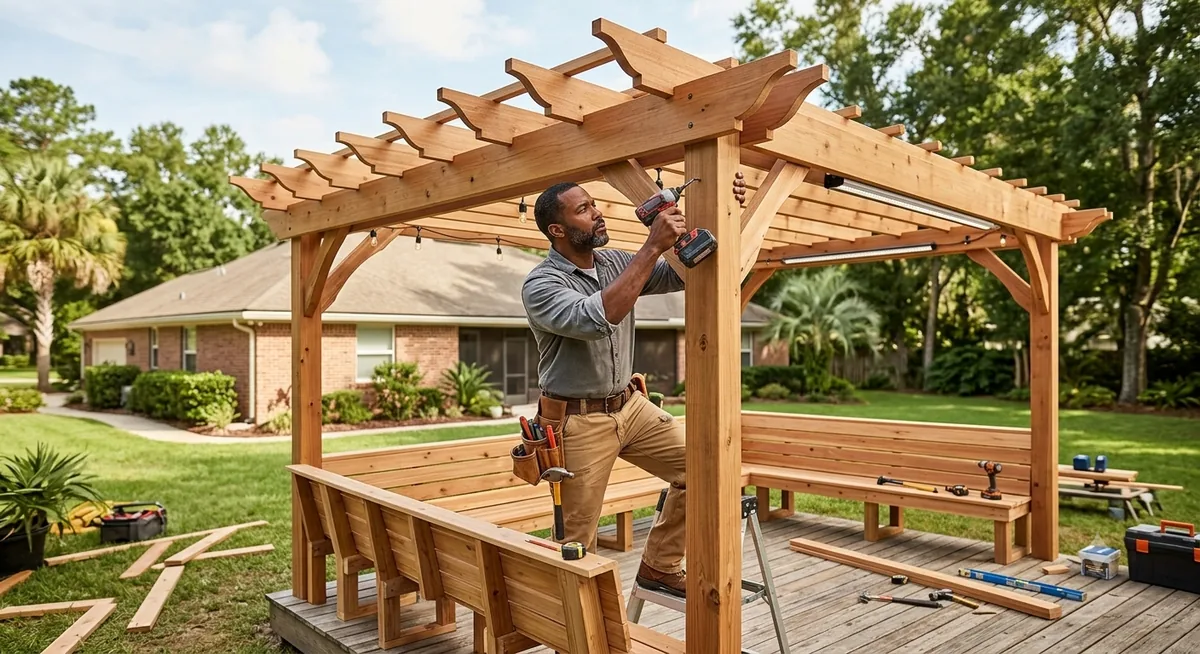
Atmosphere lighting. String lights, most commonly across a pergola. Dollar for dollar this is the highest-impact thing you can add to any outdoor space. Warm, festive, and they make an ordinary weeknight feel like an occasion. If you only do one decorative thing, do this.
The magic is in layering them. All three together, on separate switches, means you can light the stairs for safety without floodlighting the entire yard — or turn everything on when you’re entertaining.
Why low voltage
We use low-voltage LED systems for deck lighting. They’re safe around water and bare feet, they draw almost nothing, the fixtures last for years, and the wiring is far simpler to run and to zone than line voltage.
Near salt air — the beaches, the Intracoastal, the river — fixture and connector selection matters more than people expect. Cheap fixtures corrode. We spec accordingly.
The timing thing that costs people money
This is the practical takeaway, and it’s the reason we bring lighting up at the design visit rather than at the end.
The wiring has to be run while the deck is being built.
Once the boards are down, running wire means pulling boards back up. It’s a real job, it costs real money, and it’s entirely avoidable.
So even if lighting isn’t in the budget right now: let us run and cap the wire during the build. It adds very little to the project, and it means that whenever you’re ready — next year, in three years — installing the fixtures is a simple, cheap job instead of a demolition project.
This is the single best piece of advice in this article, and it costs almost nothing to act on.
What it looks like
Done well, deck lighting is subtle. You shouldn’t see the fixtures; you should see the deck. Light pooling on the stair treads. A soft glow along the railing. Warm bulbs overhead. The yard beyond going dark and the deck reading as a lit room floating in it.
That’s the difference between a deck you look at and a deck you live on. Talk to us about it at the design stage.
Thinking about a deck project?
Free on-site estimate, real material samples, written itemized quote within 48 hours.